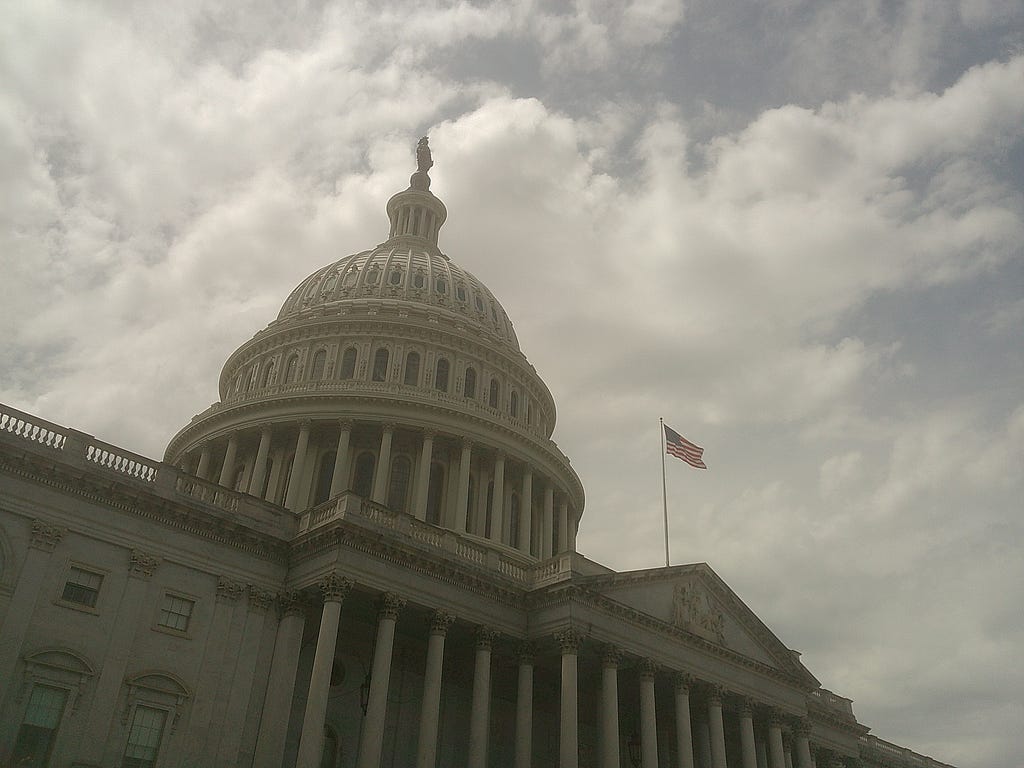

Several weeks ago, I received a curious email from the Institute for Critical Infrastructure Technology in Washington, DC. They wanted to know if I would like a press pass to attend a Congressional Summit on Critical Infrastructure & Cybersecurity on Capitol Hill.
I still do not know exactly how I ended up on that list.
I have theories. One involves a friend who works in cybersecurity who may have thought it was a funny, random prank to sign me up on their email list. But when I searched my email, I realized ICIT had apparently had my address for three or four years. So whether accident or prank… it was one of those slow-burn unfolding of events.
Either way, I was invited. The train to Washington and back was cheap enough. The event seemed semi-public. I had never been inside the U.S. Capitol Building. So I decided to treat the whole thing as a one-day field trip, lean into the soft adventure, and surrender to the path the universe lays out in front of you. That sort of thing.
I arrived. I went through security. I took a quick walk through the Capitol. I had their breakfast. I enjoyed their lunch. I sat and seriously listened to knowledgeable people talking seriously about infrastructure, cybersecurity, housing, aviation, supply chains, drones, burnout, and the systems that keep everyday life from breaking down.
I went with sincere and honest curiosity. I was not there with an agenda (other than embracing the random adventure to witness the political system firsthand). I was not there as an expert. I wan’t there to disrupt anything (somewhat interesting as one of the speakers would eventually touch on the idea of ‘disruption’). I was there as an interested citizen who had received a strange invitation and decided to take it seriously.
Because of that, I did not attribute my notes to specific speakers. What follows is not a transcript, not a formal report, and not an attempt to quote anyone directly. These are simply the things that caught my attention while I sat there trying to understand what kinds of problems people discuss when the subject is “critical infrastructure.”


Some notes from the day:
- Building strengthens the rules.
- There was mention of Pope Leo’s statement on AI.
- Infrastructure touches families more than politics. Protecting daily life, including drinking water and the power grid, should be nonpartisan.
- People and culture are part of the future.
- Companies are paying a lot of money to be the disrupter instead of the disrupted.
- The average age of the American home buyer was described as 59, with the real estate market short by about 10 million homes.
- 1974 was mentioned as the year of the last major federal housing legislation, with another housing effort expected this summer.
- Infrastructure moves people safely.
- The Build American 250 Bill was discussed in terms of preserving, repairing, and replacing.
- There are workforce shortfalls in aviation manufacturing and technology.
- Several industries need people who can read blueprints.
- The U.S. military used to lead in technology innovation. Now the private sector drives much of that innovation.
- “Ruthless prioritization” came up more than once.
- CISOs sometimes worry about employee burnout and whether critical services can continue when something happens.
- Strengthening third parties is a major supply-chain challenge.
- Historically, profits have often trumped everything, including security.
- Security education may need to start as early as K-8, and certainly by high school.
- The dynamic between defenders and attackers came up repeatedly.
- Drones were discussed as the future of warfare and as a major source of lethality in the Ukraine-Russia war.
I took the train back to New York after the Knicks beat the Spurs in Game 4, putting the series at 3–1. I missed seeing OG Anunoby’s now-legendary clutch tip-in with 1.2 seconds left live, but I heard several neighboring Amtrak passengers celebrate the moment in real time. My train arrived close to 1 in the morning, well after the game ended, but the streets were still messy with happy, loud Knicks fans.
I do have a few thoughts about how I might use my newfound, amateur, press-credential-esque skills. For the good of humanity, obviously. Is that too big a dream? Maybe. But if nothing else, I remain open to being invited into rooms I did not know I wanted to enter until someone told me I was welcome there. Meals provided are always a bonus.
Knicks in Five! The Future is Unwritten!
Be excellent to each other. Party on, dudes.


Shawn Wickens is primarily a comedian. He’s also lectured about Time Travel in five countries (and counting).
He occasionally publishes articles in which he converses with ChatGPT. He also often uses LLMs to proofread his work for spelling and grammatical errors.

