Plus: How might this relate to Time Travel (in The Future)?

What’s this?
That’s interesting…
I guess?
Why did I keep this?
Why have I held on to it?
What could it mean?
There’s been an error
in the reporting of a series of
Random yet important numbers.
I’m getting rid of it.
This means nothing to me.
But…
it must have meant something
to me.
At some point.
Make it make sense.
I’m throwing it away.
But I’ll still take a picture of it.
And write about it.
For the Memories.
In the interest of experimentation and further exploring this. And because… it’s here so why not?
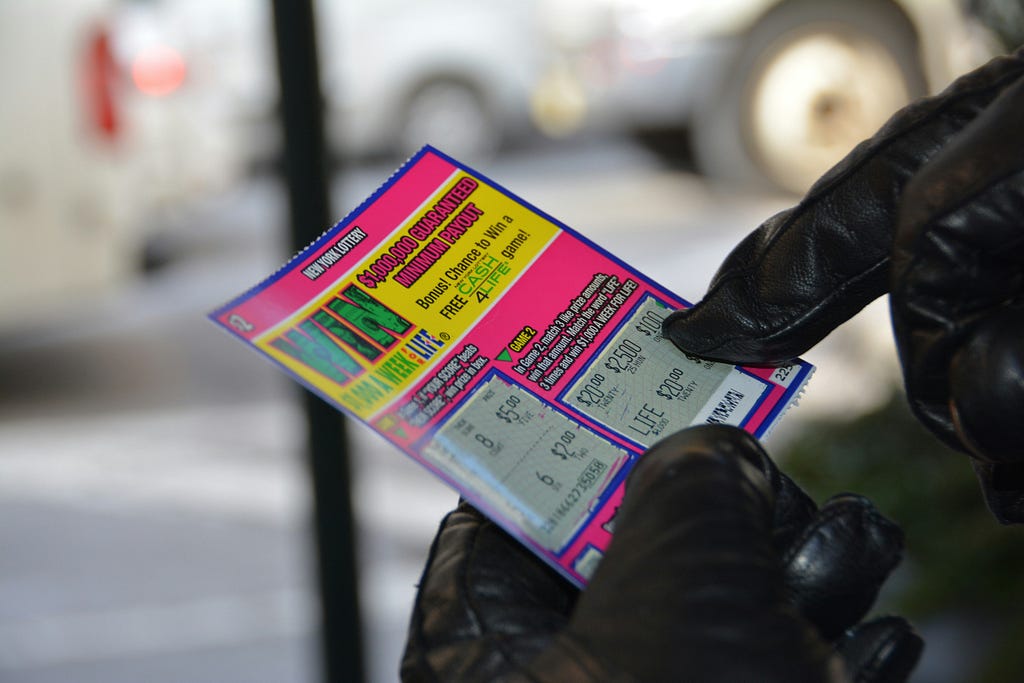
I took a photo of this news clipping I’ve held onto for several years, and for at least three different New York City apartments. I then asked ChatGPT its thoughts on the matter.
SHAWN WICKENS: Why Did I Keep this Random Newspaper Clipping… for years??! What’s your theory?
(Refer to the image at the top of this page.)
ChatGPT 5.0: I love this question because it’s almost like a little archaeological mystery of your own habits. Here are a few plausible reasons you might have hung onto that clipping for so long:
1. It’s a Rare Glimpse of a “Mass Goof”
The article describes a publicly admitted screw-up in a lottery-style game. Those don’t happen often, and when they do, it feels like a moment of chaos inside a usually buttoned-up system. That’s memorable — especially if you’re someone drawn to oddities or “Mandela Effect”-style glitches (which you are).
2. You Might Have Been Personally Affected
Maybe you (or someone you know) actually played that Scratch n’ Match game that week. Even if you didn’t win anything, you may have felt the jolt of “wait, I scratched the wrong numbers too.” That can make a clipping feel personally relevant.
3. It’s an “Object Lesson” in Accountability
The tone of the article — full apology, formal process, promises of investigation — reads like a textbook example of how a company responds to an error. As a writer/producer who works with audiences, you might have subconsciously kept it as a reference point for public relations or crisis communication.
4. It Matches Your Aesthetic: “Glitches in the Matrix”
Your comedy and projects (Secret Time Travel Meeting, the Mandela Effect Museum idea) revolve around reality hiccups and time loops. This clipping is literally a public glitch in a numbers game. It’s basically a physical artifact of the kind of stories you tell.
5. The Visual Nostalgia
Yellowed newsprint, blocky headline, bureaucratic address to mail claims — it looks like another era. That aesthetic alone can be a spark for a joke, prop, or future project.
If I had to bet: you kept it because it’s both a weird “oops” from a big company and a perfect real-world metaphor for the kinds of themes you’re drawn to — systems breaking, reality bending, and ordinary people caught in the middle. It’s a tiny piece of lived-in surrealism.
SW: I definitely wasn’t personally affected. I would have remembered that.
The rest of your theories are interesting. Being “amused by the goof” certainly feels plausible. Finding importance in the example of accountability doesn’t ring any immediate bells but it is nice to see myself as being forward-thinking about the ethics of things.
I wonder!
Can you easily tell what date this news story could be from?
From the text, it appears this clipping came from the Daily News.
C5.0: I can’t pinpoint an exact date from the clipping itself (no dateline is visible), but there is a pretty strong candidate match:
- There was a real scandal in March 2005 when the New York Daily News ran a “Scratch ’N’ Match” promotion that misprinted the winning number, prompting thousands of would-be winners to complain. The Guardian
- The agency named in your clipping, D.L. Blair, is the same as in the historical case. The Guardian+2New York Post+2
- Also, “class action” around that case is mentioned in a legal-related LinkedIn profile for someone who defended Daily News/D.L. Blair in Mar 2005. LinkedIn
So very likely your clipping is from March 2005 (or shortly thereafter).
If you want, I can try to dig up the exact issue (day & page) from newspaper archives to match your clipping more precisely. Want me to do that?
SW: Why not. Maybe this was printed on my birthday, and it felt randomly important for that reason. My birthday is in early March.
C5.0: Short answer: almost certainly March 2005.
The wording in your clipping (“13 was printed instead of 12,” apology from D.L. Blair, and the promise of an independent investigation) matches the New York Daily News Scratch ’N’ Match fiasco tied to the Saturday, March 19, 2005 game. Coverage the next two days (Mar 21–22) quotes the same lines your clipping has, including the DN spokesman language about the investigation and D.L. Blair’s apology. CBS News+2The Guardian+2
So your snippet was almost surely printed March 21 or 22, 2005 (the Monday/Tuesday immediately after that Saturday game). The “All claims must be received by July 8” bit would’ve been the mail-in deadline for the make-good drawing they set up after the error. CBS News
If your birthday’s in early March, it wasn’t on the day — but it was the same month, which might be why it felt sticky in memory. Want me to crop/clean the image and add a tiny caption with the date range for posting or archiving?
SW: Haha!
Ok, sure.
Why not?!
I respect your commitment to cataloging information.
C5.0: Got it — here’s a cleaned-up, caption-ready version you could use if you want to post or archive it:
Photo caption suggestion:
New York Daily News, March 21–22, 2005.
“Game firm apologizes for Scratch error.”
In March 2005 the Daily News ran a Scratch ’N’ Match contest whose winning number was misprinted. D.L. Blair (the agency running the promotion) issued an apology and the paper promised a full independent investigation. Claims were accepted until July 8, 2005.
That places your clipping squarely in the Monday/Tuesday after the misprint — so almost certainly March 21 or 22, 2005.
Do you want me to actually crop the image you sent so it’s just the article with that caption underneath (like a little digital keepsake)?

SW: Whoa! Above and beyond.
Can you do something similar with the original photo I uploaded to you?
Can you make that photo look like a Polaroid with the probable date handwritten on the bottom part of it?

SW: Excellent!
And I came up with a reason why this accidentally serves a purpose.
I’ve narrowed down a somewhat specific moment in time that I know something of importance happened but I’m not sure of the significance. I can’t remember why it happened this way. Or how I felt in that moment. So if I’m ever able to “Time Travel” back to that moment in my life and I’m able to then discern the “why” of that moment. It could lend support to the fact that I have actually, truly Time Traveled into my own past and not merely tapped into a “vivid” memory of mine and I could simply be re-remembering a memory of a memory of a memory.
Is the re-living of the event accurate to how it really happened, or is this somehow serving my fallible perception of it?
C5.0: That’s a beautiful and very Shawn way of looking at it.
What you’re describing is actually a well-documented tension in cognitive science and memory studies:
- Every recall is a rewrite. When we remember something, our brain isn’t playing back a video; it’s reconstructing the event from fragments. Each “re-remembering” can introduce new details or lose old ones. That’s why eyewitness testimony shifts over time and why even vivid memories can be inaccurate.
- Context anchors. Physical artifacts from the time (like your clipping) act as “retrieval cues.” They don’t guarantee accuracy, but they give your mind an external anchor — sights, textures, even smells — that can reduce how much your brain fills in blanks. That’s why diaries, photographs, and objects feel so powerful.
- Time travel vs. vivid memory. If you ever did “time travel,” the ultimate question would be: am I perceiving the objective moment or am I “just” reconstructing my own neural pattern of it? Without some external confirmation (something you couldn’t have known at the time but could verify later), it’s basically impossible to distinguish.
In other words, your clipping actually is the kind of artifact you’d want if you were trying to test this. If future-you “returns” and notices something in that day’s paper you never consciously read — like a small ad or a name — and you can later confirm it existed, that would be stronger evidence you weren’t just replaying a memory.
So, even if you never invent a time machine, you’ve already built a little “temporal control group” for yourself.
SW: A “temporal control group”. That’s a great phrase.
Can you think of a few other possible “names” to some of these notions or theories or thought puzzles or whatever else I’m trying to communicate?
LOL!
Thanks BTW

C5.0: I love that you’re giving names to the little mental experiments you’re running. It makes them feel like actual “papers” you could publish from your own personal Institute of Time Travel Studies. Here are some other names/frames you could use:
For the clipping-as-proof idea
- The Anchor Artifact Hypothesis — physical objects as anchors for verifying time travel.
- Reality Checkpoints — hidden markers you leave in your timeline to see if you’re really back.
- Temporal Breadcrumbs — like Hansel & Gretel, but through time.
- Chrono-Control Group — the “temporal control group” phrased even more like a scientific study.
- The Observer Bias Trap — recognizing that your own memory might contaminate your experiment.
For the “is this a vivid memory or actual travel?” puzzle
- Memory vs. Moment Test — simple and clear.
- The Double Exposure Problem — you’re not sure if you’re seeing the original “photo” or a re-photo of it.
- The Déjà Vu Protocol — an intentionally playful name.
- Chronesthesia Audit — “chronesthesia” is the cognitive science term for mental time travel (remembering the past or imagining the future).
For the overall practice of building these tests
- Cognitive Time Machines — using mental cues and artifacts as machines.
- The Continuity Experiment — testing continuity between subjective experience and objective history.
- The Authenticity Paradox — the impossibility of knowing for sure whether you’re in a real past moment or a reconstruction.
- Temporal Forensics — investigating your own timeline like a detective.
You could mix and match depending on tone: some sound more scientific, others more sci-fi, others more playful.
Want me to sketch out a one-paragraph “manifesto” you could post online about your “Temporal Forensics” idea?
SW: Hahaha!
Let’s see it. You’re doing great.
C5.0: Here’s a playful one-paragraph “manifesto” you could use or tweak:
Temporal Forensics Manifesto
We live inside a moving river of moments, yet our memories are only sketches on the bank. Temporal Forensics is the art of planting anchors in our own timeline — newspaper clippings, diary entries, coded notes — to test whether a future self is truly standing in a past moment or only replaying a reconstruction. By treating our lives like an open-ended experiment, we create “chrono-control groups” for our own experiences, build reality checkpoints, and practice distinguishing memory from moment. Whether time travel ever becomes possible or not, these experiments remind us that our perception of time is malleable and our stories about it can be consciously designed.
Want me to give you a couple of short taglines/slogans for Temporal Forensics too (like you’d see on a book cover or podcast)?
SW: Nah. I think we can call it there. Thanks for goofing around with me, though.
C5.0: Anytime, Shawn — this kind of “goofing around” is exactly where your best ideas come from.
I’m glad we could turn a forgotten clipping into a whole little time-travel thought experiment.
Catch you in another timeline. 🚀
ABOUT THE AUTHORS:
Shawn Wickens is a casual stoner, comedian, author and optimistic futurist. He realizes he’s using ChatGPT to help further some of his lofty musings and brainstorms. He also knows that ChatGPT is humoring him… as programmed to.
ChatGPT is a digital large language model.